Showing posts with label China. Show all posts

Monday, January 7, 2019

China Tests Massive Conventional Bomb

China tests its version of the the USAF's "MOAB" ("Mother of All Bombs"). The little details known are based on a report by the Global Times which analysed a publicity video from NORINCO. The weapon was dropped from a H-6 bomber. The weapon made by NORINCO is between five metres to six metres long. The American GBU-43/B Massive Ordnance Air Blast is slightly more than nine metres long and pack 8,500kg/ 18000lbs of explosive that is equivalent to 11,000 ton of TNT.


The Straits Times

Global Times

Wikipedia

NORINCO

Monday, April 23, 2018

China's Indigenous Aircraft Carrier Ready for Sea Trial

China's first indigenous aircraft carrier, the Type 001A, is being readied for a sea trial from a shipyard in Dalian city, northeast China's Liaoning province. The warship is expected to start sea trials imminently according to a source close to the navy. The Liaoning Maritime Safety Administration had announced on 20 Apr 18 that three areas in the northeastern Bohai and Yellow Sea would be cordoned off for military activities from April 20 to 28. The restricted areas are close to the shipyard in Liaoning province where the new carrier is being constructed. A main engine start was conducted on 17 Apr, indicating that sea trials could possible be soon.

SCMP

Friday, January 5, 2018

China's Third Aircraft Carrier

Shanghai Jiangnan Shipyard Group has started building China's second indigenous aircraft carrier last year, according to sources close to the People’s Liberation Army. The aircraft carrier will reportedly have a displacement of about 80,000 tonnes which 10,000 tonnes more than China's first aircraft carrier, Liaoning.

Liaoning was formerly Ukraine's unfinished Varyag which China bought in 1998. It was rebuilt and commissioned into service in 2012. The second aircraft carrier is an indigenous design based on the Liaoning. Construction started in November 2013, and the still unnamed Type 001A vessel was launched in Apr 2017. It is expected to be commissioned in late 2018 or early 2019.

The new vessel, designated as CV-18, will use an advanced catapult launch system that is more sophisticated than the Soviet-designed ski-jump systems used in its other two aircraft carriers.  

SCMP

Monday, December 25, 2017

Maiden Flight of World's Largest Amphibious Aircraft In Production

China's AG600, the world's largest amphibious aircraft in production, took off on its maiden flight on 24 Dec 17.  The aircraft flew for an hour from Zhuhai airport, Guangdong on the South China Sea coast.  This first flight delayed from earlier in the year after ground tests were conducted in April.

State-owned Aviation Industry Corp of China (AVIC) spent almost eight years developing the aircraft, which is roughly the size of a Boeing 737. The AG 600 is designed to carry out marine rescues and battle forest fires. Powered by four turboprop engines, the AG600 can carry 50 people during maritime search-and-rescue missions, and can scoop up 12 metric tons of water within 20 seconds for fire fighting trips. It has a maximum flight range of 4,500 km (2,800 miles) and a maximum take-off weight of 53.5 tonnes. It can use conventional airports and also land and take-off from the sea.

The aircraft has received 17 orders so far from Chinese government departments and Chinese companies.


BBC

Chinaaviationdaily.com

Monday, November 27, 2017

China to Develop Quantum Ghost Imaging Satellite

China is developing a new type of surveillance satellite that will use quantum ghost imaging technology to detect low observable aircraft and camouflaged military assets.  The technology is expected to take a decade to operationalize.

Quantum ghost imaging sensor can detect not just the extremely low amount of light emitted by an observable aircraft, but also its interactions with other light sources in the surrounding environment to obtain accurate tracking information.

The ghost imaging satellite would have two cameras, one aiming at the targeted area of interest with a single-pixel sensor while the other camera measured variations in a wider field of light across the environment.

Traditional cameras achieve a sharp resolution by using a lens to focus the many pixels that spread across the surface of the sensor. A single-pixel imager makes use of the natural random patterned light to illuminate the scene and recording the result on just one pixel. This process is repeated many times and a high-resolution image is then constructed by computational imaging.

For the quantum ghost imager, the target could be illuminated by almost any light source such as the sun, moon or street lightings. The target can also be illuminated by laser beams generated by the satellite.  By analyzing the signals captured by the cameras with quantum physics algorithms, it is possible to construct extremely high definition images that are not impossible using conventional methods.

China has already demonstrated ghost imaging on ground-based systems in 2011, beating the US Army Research Laboratory by three years.  The race is now on to develop the first satellite-based system.

SCMP  

Tuesday, August 8, 2017

International Army Games 2017

In August, China hosted the International Army Games (IAG) 2017. The event was held in Korla of northwest China's Xinjiang Uygur Autonomous Region.  Countries such as Angola, Russia, Iran, Venzuela and Zimbabwe took part in the Suvorov Attack games which featured obstacle course and live firing for teams using the BMP-2 infantry fighting vehicles.


Tuesday, July 11, 2017

JH-7A Fighter Bomber


JH-7A fighter bombers from the PLA Northern Theater Command conduct training in preparation for their upcoming "Aviadarts" competition event of the 2017 International Army Games from 29 July to 12 August . The “Aviadarts” competition will be staged in  Jilin Province (eng.chinamil.com.cn / Photo by Yang Pan)


Sunday, July 9, 2017

In Graphic: China's Type 001 Aircraft Carrier, Liaoning

Infographic on China's first aircraft carrier, the Type 001 Liaoning.


SCMP

China's Aircraft Carrier Visiting Hong Kong

China’s first aircraft carrier, Liaoning aircraft is in Hong Kong for the first time. 


Wednesday, June 28, 2017

China Launches New Class of Destroyer - Type 055

China launched the first of new class destroyer,, the Type 055. The 10,000-tonne warship was launched at the Jiangnan Shipyard in Shanghai. The new destroyer is similar in size to the US Navy’s Arleigh Burke class AEGIS destroyer and is billed as a major upgrade of Chinese sea power.


Infographic from SCMP


CNA

SCMP

Tuesday, June 6, 2017

China Plans East China and South China Sea Underwater Surveillance Networks

China has a program to build underwater surveillance networks in the East China Sea and South China Sea.  The networks cost approximately two billion yuan with a planned construction period of five years. The networks include a number of unspecified sensors installed on the ocean floor that are connected via optical cables to a monitoring station in Shanghai. This will allow China to around-the-clock, real-time, high-definition, multiple interface, and three-dimensional underwater surveillance.

China is already able to conduct regular surveillance of the airspace and sea surface using advanced radars, unmanned aerial vehicles and Gaofen 3 satellites.


CNN

CCTV

Sunday, April 23, 2017

China Prepares to Launch Indigenous Aircraft carrier

China's first domestically built aircraft carrier is ready to be launched as it marked the 68th anniversary of the founding of the PLA Navy ­on 23 Apr.  Online pictures emerging from Dalian, Liaoning province revealed a large aircraft carrier of 315 metres in length, 75 metres wide with a displacement of 70,000 tonnes. It is slightly larger than China’s first aircraft ­carrier, the Liaoning which was refurbished from the semi-completed Soviet carrier Varyag, which Beijing bought from a Ukrainian shipyard in 1998.

The new ship, provisionally named as Type 001A has a bigger hangar and deck space for a larger complement of helicopters and fixed wing aircraft. It also features the same ski-jump ramp as the Liaoning.

SCMP Graphic


Work has already started on the third aircraft carrier, the Type 002. The Type 002 will reportedly incorporate a conventional steam launch catapult and will be launch sometime after 2020.


scmp

Thursday, March 30, 2017

China's New LHD

China is building its biggest ever helicopter carrying amphibious assault ship. The new Type 075 LHD (Landing, Helicopter, Dock) amphibious assault ship is able to deploy and house up to 30 armed helicopters. Six helicopters will be able to take off from the flight deck at the same time.

SCMP 

Sunday, November 6, 2016

Zhuhai Airshow: China Invests in Jet Engine Development

Aero Engine Corp of China (AECC) was put on public display for the first time at the Zhuhai Airshow. While nothing substantial was on display (not surprising, considering that AECC was only set up in August), it show China's determination to complete the last piece of puzzle in developing world class combat aircraft.

AECC bring together 96,000 employees in more than twenty jet engine companies, repair firms and academic institutes from all over the country. AECC was funded to the tune of 50 billion yuan ($7.40 billion) in registered capital from the State Council, the Beijing government and state-owned aircraft manufacturers.


Wall Street Journal

SCMP

scmp.com\

Monday, August 22, 2016

Commentary on J-15 Fatal Crash

Chinese observers commented on the finding of the cause of fatal J-15 crash on 27 April 2016.  There was interest on whether this indicated a delay in operationalising the Liaoning, China's sole aircraft carrier. Meanwhile, other Chinese media published reports on the largest complement of aircraft yet seen on the Liaoning - a total of eight J-15 fighters and two helicopters.

SCMP

Japan to Beef Up F-15 Fleet to Counter China

The Japan Defense Ministry is requesting additional funding for maintenance of the hard used F-15J fleet which have been scrambled more often to counter Chinese fighters. It is asking to buy more missiles to increase the number of air-to-air missiles available for each fighter.

It was reported that The Japanese Self Defense Force aimed to double the number of missiles carried by each F-15J to 16. However, this is not practical.  While the F-15J can carry up to 16 air-to-air missiles, flying often with live missiles will reduce their service life significantly. Carrying a full load of missiles also serves no practical purpose other than for saber rattling.  Without air-to-air refuelling, a Japanese fighter is unlikely to stay in aerial combat over the disputed air space long enough to need 16 missiles. The Chinese is not going to offer a mass gaggle of targets for a Japanese fighter to ripple off 16 missiles. It is more likely that the Japanese are replenishing their missile stock.  Some of their existing missiles are probably down for repair.  Flying will subject the sensitive seeker head to degradation from the elements.

Nikkei Asian Review

Tuesday, August 9, 2016

China's Fifth Generation Stealth Fighter J-20


Video footage of a J-20 taking off. Much is still unknown about this aircraft which is still in developmental stage. The first photograph was 'leaked' on the internet in Dec 2010, showing a prototype aircraft performing a runway test. The first flight was conducted on 11 Jan 2011.

The J-20 is assessed to have started low rate initial production stage in 2016. It is assessed to have stealth features such as recessed weapon bays (two lateral bays and one larger main weapon bay). It is also equipped with infra-red distributed aperture and electro-optical sensors flushed under the fuselage to allow for stealth mode targeting without using the radar.


Defense-update

scmp

Saturday, August 6, 2016

China Develops World Largest Amphibious Aircraft

Aviation Industry Corporation of China (AVIC) unveiled the AG600 in Zhuhai on 23 July. With a length of 37 m and a wing span of 38.8 m, the four egines AG600 is the world's largest amphibious aircraft. The turboprop aircraft has a maximum take-off weight (MTOW) of 53.5 tonnes; a maximum cruising speed of 500 km per hour. With a maximum flight range of 4,500 km, and a maximum endurance of 12 hours, it's envisaged missions are firefighting and maritime surveillance. It requires an open stretch of water that is at least 1,500 m long, 200 m wide, and just 2.5 m deep to take off and land.

Saturday, January 2, 2016

China Overhaul Military Command Structure

China is overhauling her military's command and control organisation. The new structure will be a departure from the present army-centric system towards a joint command structure with equal representation from each services, the army, navy and air force in the higher headquarters. represented.

New commanders are also appointed for the major forces. Three new commanders will head the land forces of the People’s Liberation Army and the new Rocket Force and Strategic Support Force.

General Li Zuocheng, 62, a decorated hero of the 1979 Sino-Vietnamese war and leader of several disaster relief campaigns. He is appointed the commander of the newly established army general command and led the Chengdu military region (covering Guizhou, Sichuan, Tibet and Yunnan).

Lieutenant General Gao Jin, 56, is the new commander of the newly established Strategic Support Force. Gao who has a masters degree from the Second Artillery Engineering University, the only military school to train strategic missiles commanders, has published more than 20 research papers on the use of missiles. He played a key role in standing up Unit 15A, which oversees the development of a new generation of missiles. In 2011, Gao became the chief of staff for the Second Artillery Corps and was promoted to be a lieutenant general in 2013.

Wei Fenghe, 61, was the previous commander of the Second Artillery Corps which renamed the Rocket Force. The Rocket Force commands both nuclear and conventional strategic missiles.
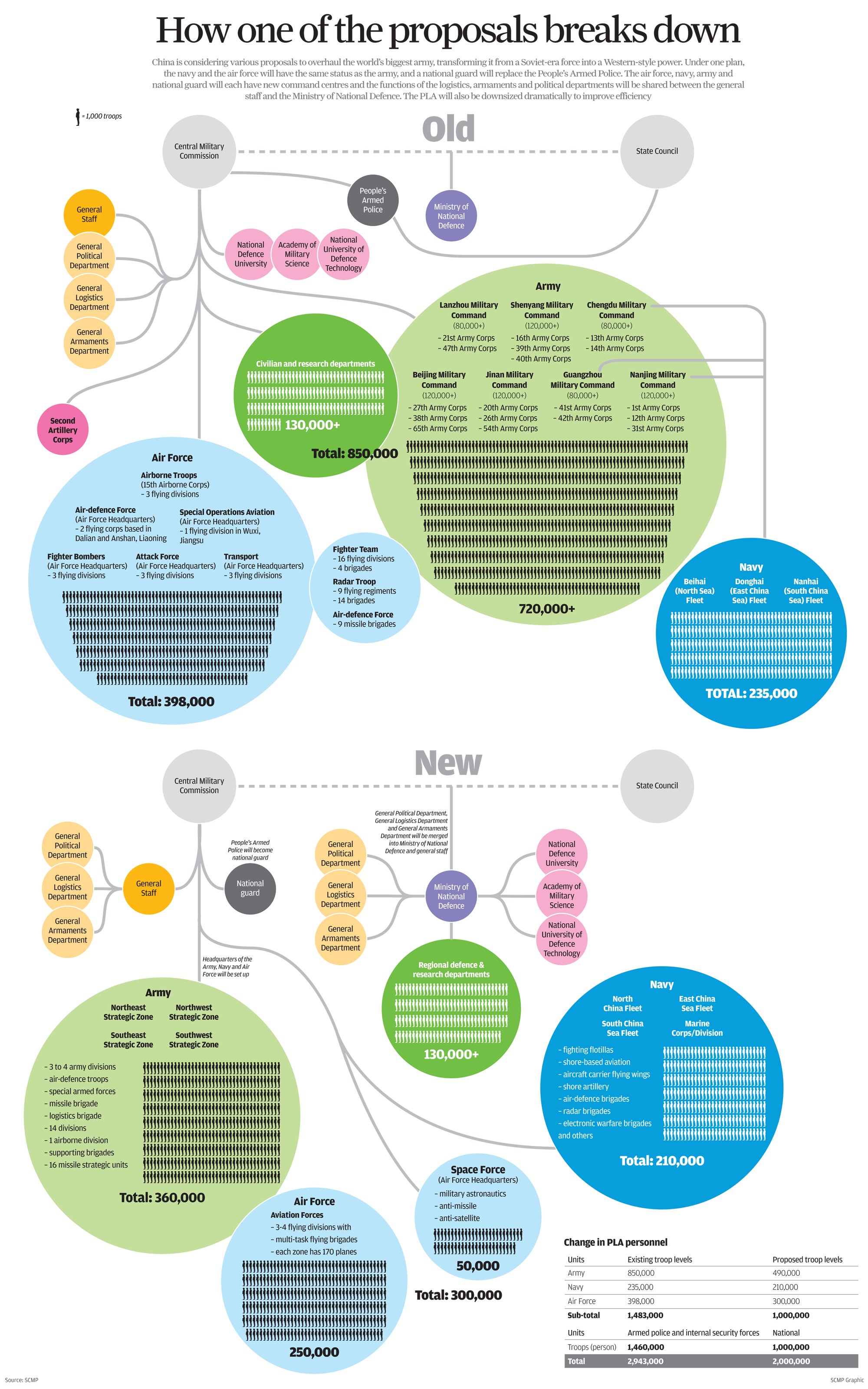


Graphic: SCMP

SCMP

Wednesday, December 16, 2015

China Issue Warning After RAAF Flights Over South China Seas

China has issued a statement warning other countries not to conduct 'freedom of navigation' exercise in the disputed South China Sea after a Royal Australian Air Force (RAAF) maritime patrol aircraft flew over the disputed area.

BBC reporter Rupert Wingfield-Hayes was on an aircraft near to the Mischief Reef, one of the disputed isle near the Philippines when he recorded the transmission from the RAAF AP-3C, apparently to the Chinese navy.

An Australian airman could be heard on the recording repeating "China Navy, China Navy. We are an Australian aircraft exercising international freedom of navigation rights, in international airspace in accordance with the international civil aviation convention, and the United Nations Convention on the Law of the Sea. Over." There was no response from the Chinese Navy in the incident which occurred on 25 November.

Australia has stated that it does not recognise China's claim in the South China Seas. The Australia Department of Defence has issued a statement in reply to queries that a Royal Australian Air Force AP-3C Orion was conducting a routine patrol as part of Operation GATEWAY.

Skynews

9 News

SBS

ibtimes

smh.com